Thursday, January 13, 2011

Feds to Tighten School Nutrition Standards


As part of Obama's goal to prevent the increasing percentages of obese Americans, the US Department of Agriculture announced a new proposal in order to create a more healthy food environment for American schools. This proposal would enhance the multiplicity of fruits and vegetables, whole grains, as well as low-fat and skim milk. Furthermore, this rule will reduce the amount of saturated fat and sodium common in many of the available cafeteria foods. Foods such as pizza and french fries will no longer be in abundance.
In my opinion, this new proposal should be put into effect immediately. This new proposal will slow down the rising numbers of obese Americans. Schools should strive for a more healthy atmosphere for their students. All in all, this rule is a great idea because it will a wholesome environment for the students.

Article: http://www.cnn.com/2011/HEALTH/01/13/school.nutrition/index.html

Picture: http://www.google.com/imgres?imgurl=http://image.shutterstock.com/display_pic_with_logo/83052/83052,1176499953,1/stock-photo-different-salads-in-buffet-healthy-food-3077420.jpg&imgrefurl=http://www.shutterstock.com/pic-3077420/stock-photo-different-salads-in-buffet-healthy-food.html&usg=__i6ljSBWxSwTsX4kT8SYHWQG7brI=&h=321&w=450&sz=62&hl=en&start=0&sig2=35JpixPxaGsgk0vjK2rqvw&zoom=1&tbnid=p79GPkl76M1BNM:&tbnh=137&tbnw=192&ei=QaUvTYf0GcLflgetoq2pCg&prev=/images%3Fq%3Dhealthy%2Bfood%2Bbuffet%26hl%3Den%26biw%3D1280%26bih%3D845%26gbv%3D2%26tbs%3Disch:1&itbs=1&iact=hc&vpx=446&vpy=498&dur=1762&hovh=190&hovw=266&tx=123&ty=209&oei=QaUvTYf0GcLflgetoq2pCg&esq=1&page=1&ndsp=24&ved=1t:429,r:14,s:0

Thursday, December 2, 2010

New Jersey Deciduous Forests

Hello! Come and listen to the I Wonder radio station and this week's interesting topic...New Jersey Deciduous Forests! On this recording located at, http://www.podomatic.com/profile, we discuss the importance of forests and what will happen if we don't save them. One major forest in New Jersey is Stokes State Forest in northern New Jersey, covering approximately 15, 482 acres of land! However, deciduous forests are located all around the world including Europe, eastern North America, China and Japan! So come and listen to our podcast!


Citations:

The Brown Reference Group plc. Ecology, Danbury: Grolier, 2004. Print.

Fink Martin, Patricia A. Woods and Forests. Danbury: Grolier, 2000. Print.

Fiset, Nathalie. "The Positive and Negative Consequences of Deforestation." EzineArticles.com. 29 Nov. 2010.

Jasch, Mary. "Stokes State Forest" New Jersey's Great Northwest Skylands, Jan. 2010. Web. 27 Nov. 2010. .

Manta. "16 Logging Companies in New Jersey." Manta Find Companies Connect with Customers. Manta. Web. 29 Nov. 2010. .

Sayre, April. Temperate Deciduous Forest. Brookfield: Twenty-First Century Books A Division of The Millbrook Press Inc., 1994. Print.

Sunday, October 17, 2010

Topsoil Niches


This is a picture of topsoil I found in my backyard. It plays many important niches, or roles, in my backyard community. For example, it provides nutrients for my garden where I grow many vegetables in the summer. Moreover, it provides a home for many worms, which enrich the soil. All in all, topsoil is very important to not only humans but worms as well. It helps produce different types of foods and provides shelter for annelids which poduce fertile soil.
Picture taken by JetsFan21

Wednesday, September 29, 2010

Sun-Abiotic Factor


What would life on Earth be like if there wasn't a sun? Well, there wouldn't be any life. The sun is a very important abiotic factor (a non-living feature of an ecosystem that limits population size). First, the sun is essential during the process of photosynthesis, when plants make their own food. Without the sun, all plants would die. Many animals such as herbivores, omnivores and humans would perish without plants because they provide food and oxygen. The sun also creates a suitable environment for us to live in, not too hot or not too cold. It also regulates temperature, precipitation, air mass movement and radiation. These things are all vital to our life on Earth.

Picture take by JetsFan21
I got information from www.globio.org/glossopedia/article.aspx?art_id=37
http://wiki.answers.com/Q/Why_is_the_sun_an_important_abiotic_factor_for_all_organisms
www.biology-online.org/6/3_abiotic_factors.htm

Wednesday, May 26, 2010

Storm Project

Are you interested in learning more about tornadoes? Visit this website!

http://www.yellowscience.webs.com/

Tuesday, May 18, 2010

Lit. Poems

"Family"

Friends
Amiable, generous
Loving, caring, sharing
Selfless, devoted, Papa, togetherness
Breathing, playing, whispering
Friendship, safety
Accordion

"Hans Hubermann"

Hans Hubermann
Generous, loyal, dedicated
Who loves to spend time with Liesel
Who feels guilty about Erik Vandenburg
Who needs his cigarettes
Who shares his musical talent with his family
Who fears the revealing of Max
Who'd like to see a peaceful world
Who dreams of a successful future for Liesel
Who ends up dying in a raid


Monday, May 17, 2010

Cloud Lab


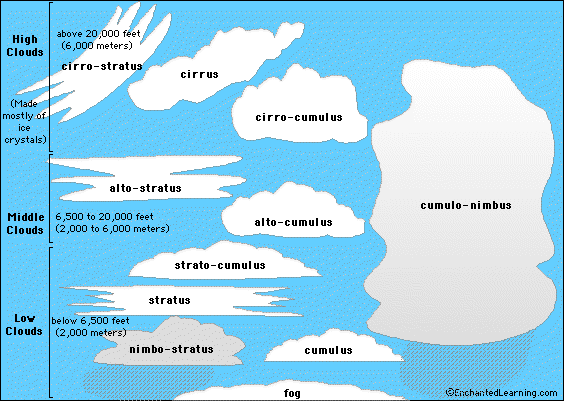
We did a lab in science class, and now I have a better understanding of how clouds forn. In this lab, a ringstan about two feet high supported a tin can full of ice cubes. Under the tin can was a teapot full of water. My group turned on the teapot and watched as the steam, or water vapor, was produced from the pot. The steam rose and condensed onto the tinpan since it was a cool surface. After a few minutes, the tin pan started raining! I gained a lot of knowledge from this activity, but here are the top three interesting facts. Firstly, clouds need to attach to something in the air, such as dust particles, in order to stay aloft. In this lab, the tin can represented the dust particles since that is where the water droplets condensed. Secondly, in order for a cloud to produce rain, the water droplets need to be large enough in order for them to fall out of the cloud. I watched as a bunch of tiny condensed cloud droplets gathered, and formed a large raindrop. Thirdly, the process of the teapot producing water vapor is called evaporation. This is how the steam rose to the tin can in the first place. I further researched this topic, and discovered two more intriguing pieced of information. Cloud droplets are approximately one thousand times smaller than a raindrop, having a diameter of about ten thousandths of an inch. Secondly, the largest cloud is six mile high in the sky and can hold up to 500,000 tons of water! This cloud is known as the cumulnimbus cloud. In conclusion, I enjoyed this lab and I have a better understanding of how clouds form. I think it is important to know about weather because you experience it every day. The next time it rains, I'll know that the cloud droplets gathered and the cloud can no longer sustain the water, therefore it will rain. I'm excited to share my knowledge with other people.


Picture- www.enchantedlearning.com/cgifs/clouds.GIF